

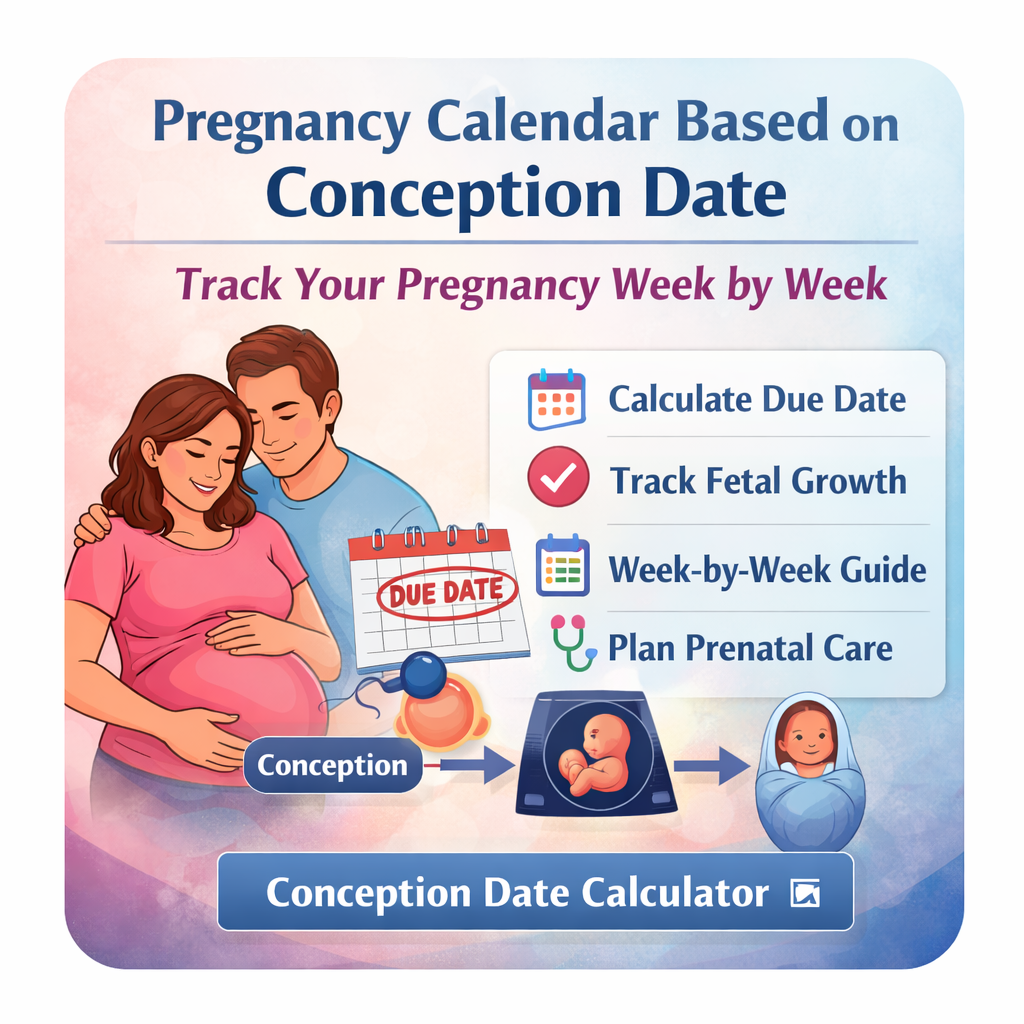
If you know the exact day you conceived, you have a unique advantage. A pregnancy calendar based on conception date gives you a clearer and often more precise timeline than the traditional method based on your last menstrual period (LMP).
Most healthcare providers calculate pregnancy from LMP, which assumes ovulation happened on day 14 of a 28-day cycle. But cycles vary widely. If you tracked ovulation or conceived through IVF, using a conception-based pregnancy calendar may give you a more accurate picture of your baby’s true developmental age.
In this guide, we’ll explain how it works, how to calculate your due date, and what to expect week by week.
What Is a Pregnancy Calendar Based on Conception Date?
A pregnancy calendar based on conception date tracks pregnancy starting from the actual day the egg was fertilized rather than from the first day of your last period.
Quick Definition (Featured Snippet Ready)
A pregnancy calendar based on conception date calculates pregnancy progress from the day of fertilization. It reflects the baby’s true biological age and estimates a due date 38 weeks (266 days) from conception.
Why Use Conception Date Instead of LMP?
Traditional pregnancy dating adds about two weeks before ovulation. That’s because medical gestational age starts before fertilization occurs.
However:
- Ovulation doesn’t always happen on day 14
- Many women have irregular cycles
- Conception may occur earlier or later than expected
According to the U.S. Office on Women’s Health (womenshealth.gov), pregnancy is typically counted as 40 weeks from LMP, even though fertilization usually happens about two weeks later. You can read more about official pregnancy timing guidelines here.
If you know your exact conception date, adjusting your calendar can better match ultrasound findings and fetal development.
How to Calculate Pregnancy Based on Conception Date
If you know your conception date, calculating your estimated due date (EDD) is simple.
Step-by-Step Formula
- Identify your conception date.
- Add 266 days (38 weeks).
- The result is your estimated due date.
Pregnancy lasts about:
- 38 weeks from conception
- 40 weeks from LMP
If you prefer an easier method, you can use an online tool like this conception-based pregnancy calculator:
It quickly shows:
- Estimated due date
- Current pregnancy week
- Trimester stage
- Key milestone timeline
Week-by-Week Pregnancy Calendar Based on Conception Date
Below is a trimester overview using conception as week 1.
First Trimester (Weeks 1–13 from Conception)
This is the foundation stage. Major organs begin forming early.
Weeks 1–2: Fertilization and Implantation
- Sperm fertilizes egg
- Zygote travels through fallopian tube
- Implantation into uterine lining
- hCG hormone production begins
You may not notice symptoms yet.
Weeks 3–4: Early Embryonic Development
- Neural tube forms (future brain and spinal cord)
- Heart begins developing
- Placenta starts forming
Common early symptoms:
- Mild cramping
- Fatigue
- Breast tenderness
- Light spotting
Weeks 5–8: Organ Development
This is a critical stage of fetal development.
- Heartbeat detectable via ultrasound (around 6–7 weeks)
- Limb buds appear
- Facial features begin forming
- Major organs develop
By week 8:
- Baby is about the size of a raspberry
- Rapid cell growth continues
Weeks 9–13: Growth and Stabilization
- Embryo becomes a fetus
- Fingers and toes are fully formed
- External genitalia begin developing
- Nausea may peak
By week 13:
- First trimester ends
- Risk of early miscarriage decreases compared to earlier weeks
Second Trimester (Weeks 14–27 from Conception)
Often considered the most comfortable trimester.
Weeks 14–18
- Baby begins moving
- Facial expressions develop
- Ears move into final position
Weeks 19–22
- You may feel first kicks (quickening)
- Anatomy scan typically performed
- Baby’s sex often visible
Weeks 23–27
- Lungs continue developing
- Baby gains body fat
- Hearing improves
With modern neonatal care, survival rates for babies born after 24 weeks have improved significantly, though complications remain possible.
Third Trimester (Weeks 28–38 from Conception)
Your baby focuses on growth and final organ maturity.
Weeks 28–32
- Rapid brain development
- Eyes open and close
- Stronger movements
You may experience:
- Back discomfort
- Braxton Hicks contractions
- Sleep disturbances
Weeks 33–36
- Baby usually turns head-down
- Weight gain accelerates
- Lungs mature further
Weeks 37–38 (Full Term from Conception)
Baby is:
- Fully developed
- Ready for birth
- Continuing to gain weight
From a medical perspective, this equals about 39–40 weeks gestational age.
Key Milestones in a Conception-Based Pregnancy Timeline
- Heartbeat detectable: 6–7 weeks
- Brain development begins: Week 3
- First movements felt: 18–22 weeks
- Lung maturity: Late third trimester
- Full term: 38 weeks from conception
Benefits of Using a Pregnancy Calendar Based on Conception Date
Using conception-based dating can:
- Improve due date precision
- Align ultrasound growth measurements
- Reduce confusion for irregular cycles
- Help IVF patients track exact development
It is especially useful if:
- You tracked ovulation
- You used fertility treatments
- Your LMP is uncertain
FAQ: Pregnancy Calendar Based on Conception Date
1. Is a pregnancy calendar based on conception date more accurate?
Yes — if you know your exact conception date. It reflects true fetal age instead of estimated gestational age.
2. Why do doctors count pregnancy from the last period?
It’s easier to track because most women know their last period date, while conception is often unknown.
3. How do I convert conception weeks to medical pregnancy weeks?
Add two weeks.
Example:
- 10 weeks from conception
- Equals 12 weeks gestational age
4. Is conception date used in IVF pregnancies?
Yes. In IVF, fertilization timing is known precisely, so doctors calculate due dates from embryo transfer or fertilization date.
5. Can ultrasound override conception-based dating?
Yes. First-trimester ultrasound is considered the most accurate way to confirm gestational age if there is a discrepancy.
Medical Disclaimer
This article is for educational purposes only and does not replace professional medical advice. Always consult your healthcare provider regarding pregnancy dating, due dates, and prenatal care decisions.
Final Thoughts: Should You Use a Conception-Based Pregnancy Calendar?
If you know your conception date, using a pregnancy calendar based on conception date can give you a clearer, more personalized timeline of your baby’s development.
It helps you:
- Understand true fetal age
- Estimate a more accurate due date
- Track milestones confidently
For the easiest calculation, use a reliable tool like and always confirm important dates with your healthcare provider, especially after your first ultrasound.
Pregnancy is a journey measured in weeks — and starting from conception may give you the clearest map forward.
