

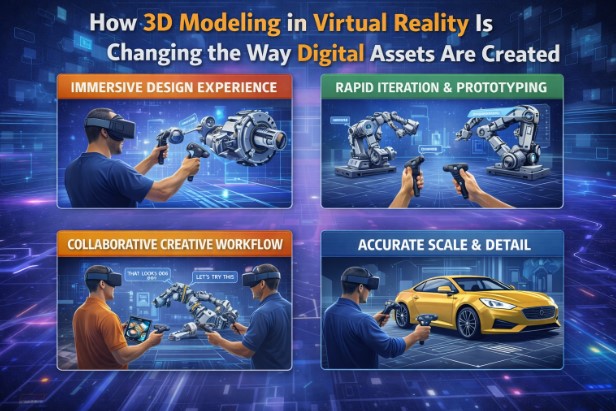
Traditionally, the creation of digital assets has been bound to flat screens, indirect controls, and workflows that force artists to think through two-dimensional inputs for three-dimensional results. These very tools have powered decades of innovation, but ultimately constrain how intuitively creators can work with space, scale, and form.
However, with immersive technologies maturing, a new paradigm takes hold where 3D modeling in Virtual Reality remakes how digital assets are conceptualized, shaped, and refined.
Reimagining the Creative Workplace
Virtual reality completely changes the modeling environment itself. Rather than being oriented via camera views and viewport controls, creators share a spatial workspace in which assets exist at real or exaggerated scale. This changes how decisions get made.
As the artists are working in a virtual environment, spatial relationships present themselves immediately. Proportions are no longer an idea but something experienced. The end result is more confident, creative decisions early in the process when changes are easiest and most effective.
The workspace becomes less about juggling tools and more about shaping ideas directly.
Direct Interaction with Form and Space
Traditional modeling is highly based on abstraction: vertices, edges, and numeric values manipulated via mouse or tablet. Virtual Reality replaces abstraction by direct interaction.
Designers mold, stretch, and smooth out shapes with the subtlety of their hands. Perhaps for that reason, it can even feel intuitive when working with very complex geometries.
This direct interaction encourages:
- Faster decision-making
- Greater confidence in form and volume
- Reduced reliance on constant viewpoint changes
The result is a more fluid creative process, one that focuses on shape and intent over interface mechanics.
Improved Sense of Scale and proportion
It is one of the hardest things to get right on a flat screen. The things that look correct on their own can feel wrong when they are in context or in the game environment.
Working in immersive space lets artists experience assets at their intended size: a door feels like a door, a vehicle feels massive or compact as intended, and the environments have true spatial presence.
3D modeling in VR greatly enhances early-stage scale accuracy in production workflows, reducing adjustments and rework downstream.
Accelerating Concept Development
Early creation of assets is all about speed and experimentation. VR shines in this regard because it lets artists block out ideas quickly without concern for precision or technical constraints.
The ideas organically take shape when creators walk around their work, review from multiple perspectives, and make immediate changes.
Developing Creative Confidence and Flow
Technical friction refers to the fact that switching between tools, interface complexity, and constant view-setting adjustments disrupt the creative flow. VR reduces interruptions and keeps creators focused on the asset itself.
Many artists report that during VR modeling sessions, they feel much more immersed and creative.
It leads to a more expressive form and daring creative choices in ideation, particularly.
Collaboration in Shared Virtual Spaces
Creation in digital assets across teams and disciplines is becoming increasingly collaborative. VR introduces new ways for teams to collaborate by enabling shared virtual environments.
Designers, artists, and stakeholders may review the assets together in the same space, pointing out issues, discussing proportions, and suggesting changes in real time. This shared context reduces misunderstandings and accelerates feedback loops.
Collaboration is experienced and not described; clarity and alignment are increased.
Bridging Artistic Vision and Technical Execution
One longstanding problem in creating assets has been translating the artistic vision into production-ready assets. Concept artists, modelers, and technical teams often work in separate phases, which fosters gaps in interpretation.
VR modeling can help preserve artistic intent by allowing creators to establish form, scale, and spatial relationships early on. These foundation decisions carry through the pipeline, providing clearer guidance for refinement, optimization, and integration.
This is because the asset follows a natural evolution, rather than being reconstructed from abstract references.
Integration with Existing Pipelines
For all its immersion, VR modeling has not supplanted traditional tools but rather augmented them: in most cases, assets created in VR migrate to normal modeling software for refinement, topology cleanup, and optimization.
Most studios apply VR for:
- Early sculpting and blocking
- Environmental layout and spatial planning
- Initial exploration of character form
This hybrid approach lets teams take advantage of immersive creativity while maintaining technical rigor downstream.
Increasing Access to Asset Creation
Traditional tools for 3D modeling can be intimidating for neophytes or nontechnical contributors. VR lowers that barrier by making asset creation more physical and intuitive.
This accessibility allows:
- Faster onboarding of junior artists
- Increased participation of designers and stakeholders
- Broader creative participation
While technical expertise is still needed for final assets, VR allows for more voices at an earlier point in the creative process.
Ensuring Quality and Production Standards
Immersive creation does not eliminate the need for discipline. Assets still need to be built for topology, performance, and compatibility.
This is where professional 3D modeling services come in to refine the assets created from these experimental or immersive workflows into production-ready deliverables meeting set standards.
What really makes VR modeling work is a combination of creative freedom and technical structure.
Shaping the Future of Digital Asset Creation
As VR hardware becomes more comfortable and software tools more precise, immersive modeling will become the standard part of asset creation rather than a niche technique.
Studios that experiment with VR today gain valuable experience in spatial workflows, preparing them for pipelines where immersive creation will be a default expectation.
This means the creative process increasingly shifts from tool management to experience shaping.
Conclusion
The evolution in creating digital assets is one toward even greater immersion, intuitiveness, and spatial awareness. Allowing creatives to work inside their designs, 3D modeling in virtual reality not only changes how assets are built but also how creative decisions are made.
