

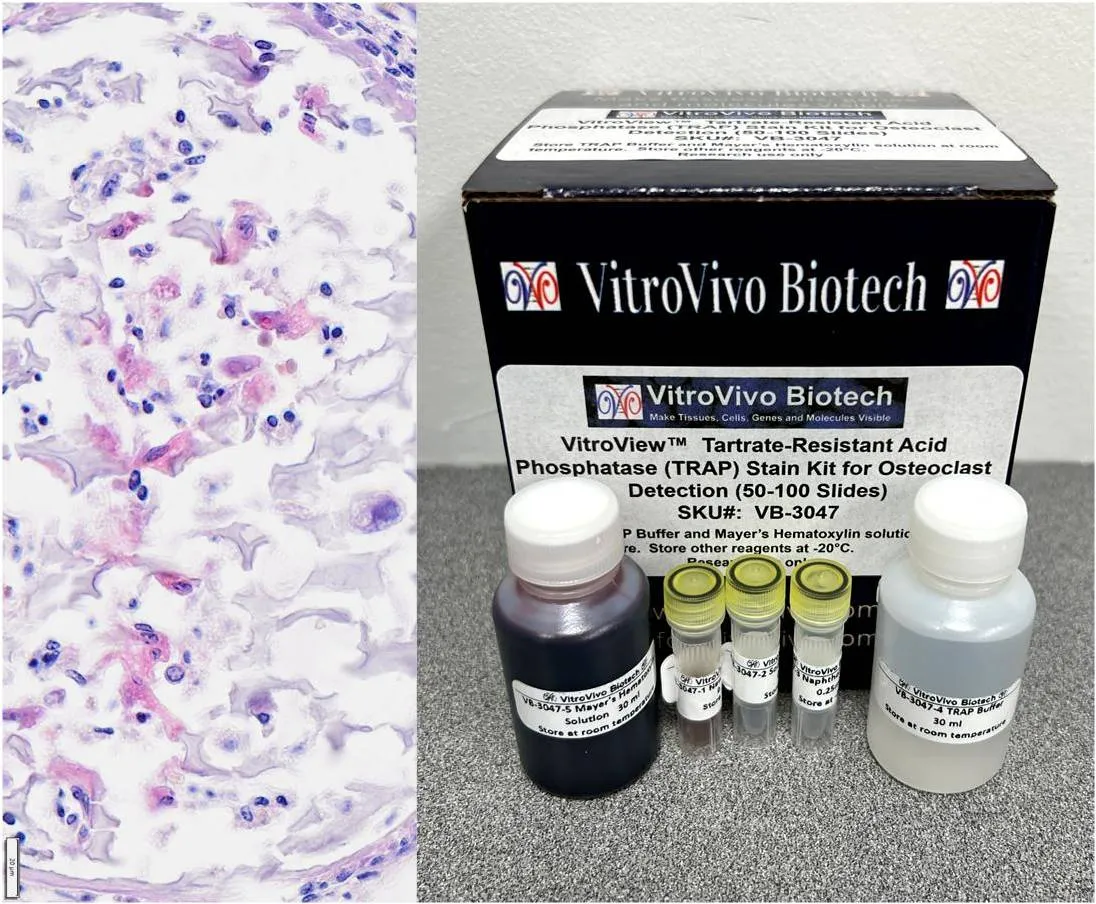
Bone and connective tissue studies often require researchers to examine more than general morphology. Changes in cell activity, collagen organization, and tissue remodeling may occur together, but each feature needs a suitable method. A TRAP stain kit osteoclast can help identify osteoclasts by demonstrating tartrate-resistant acid phosphatase activity in tissue sections or cell preparations.
This enzyme-focused approach is useful when the research question involves bone resorption or osteoclast differentiation. Tissue remodeling can also involve expansion or reorganization of connective tissue, which requires a different staining strategy and a broader view of extracellular matrix changes.
Choose the Signal That Matches the Question
Osteoclasts are specialized multinucleated cells involved in bone resorption. TRAP histochemistry is commonly used because these cells show strong tartrate-resistant acid phosphatase activity, producing a visible reaction that helps researchers locate and evaluate them within bone-related samples.
Researchers considering the best stain for fibrosis should first define what they want to measure. Fibrotic change may involve collagen accumulation, altered fiber organization, or broader connective-tissue remodeling, so the most appropriate stain depends on whether the goal is general collagen assessment, fiber differentiation, or another structural feature.
Study Bone Resorption at the Cellular Level
TRAP staining can be applied to paraffin sections, frozen sections, adherent cells, and cell smears when preparation follows the required workflow. In bone research, multinucleated TRAP-positive cells are typically evaluated as osteoclasts within the appropriate morphological context.
This makes the method useful for studies of osteoclast differentiation, bone remodeling, and resorption. Researchers may compare cell number, distribution, or staining patterns between experimental groups while keeping section preparation and imaging conditions consistent.
Separate Cellular Activity From Matrix Change
Bone remodeling is not controlled by osteoclasts alone. Changes in extracellular matrix, collagen deposition, or fibrotic tissue can develop alongside alterations in cellular activity, making it important to avoid treating one stain as a complete picture.
Using adjacent sections can help researchers examine these different dimensions. One section may be used for enzyme histochemistry, while neighboring sections can be stained for collagen or other connective-tissue components to provide structural context around the cellular findings.
Select Connective-Tissue Stains Carefully
Several histochemical methods can demonstrate connective tissue, but they emphasize different features. Masson’s trichrome can distinguish collagen from muscle, while Picro-Sirius Red highlights collagen fibers and can provide additional information under polarized light.
Reticulin, elastic-fiber, and multicolor connective-tissue stains may suit other questions. The choice should be based on tissue type, expected changes, imaging method, and whether the study needs simple detection or more detailed assessment of fiber organization.
Control Pre-Analytical Variables
Fixation, decalcification, section thickness, deparaffinization, and reagent timing can influence the final result. Bone specimens deserve special attention because some decalcification methods can affect enzyme activity or tissue chemistry.
Researchers should document processing conditions and keep them consistent across groups. If TRAP activity and collagen organization will be compared, planning the workflow before processing helps prevent one preparation step from compromising a later assay.
Use Controls to Confirm Performance
Positive controls help demonstrate that staining chemistry is working as expected. For TRAP studies, bone regions with known osteoclast activity can provide a useful reference, while connective-tissue stains benefit from controls containing the relevant structural component.
Controls should be processed alongside research samples whenever possible. This allows investigators to recognize changes caused by reagent performance, incubation conditions, or technical variation before interpreting them as biological differences.
Standardize Counting and Imaging
Microscopic evaluation becomes more reproducible when researchers define how results will be measured before reviewing all slides. TRAP-positive multinucleated cells may be counted within selected regions, while connective-tissue staining may be assessed by area, intensity, or structured scoring.
Imaging conditions should remain consistent. Magnification, illumination, exposure, region selection, and digital processing can change apparent staining patterns, so standardized acquisition is essential when comparing groups or performing image analysis.
Interpret Remodeling as a Combined Process
Cellular activity and extracellular matrix change represent different parts of tissue remodeling. An increase in osteoclast activity does not automatically predict fibrosis or collagen deposition, and structural remodeling does not by itself define the activity of bone-resorbing cells.
A stronger study design treats these findings as complementary measurements. By examining cellular markers and connective-tissue architecture separately, then interpreting them together, researchers can build a clearer picture of how tissue changes across an experimental model.
Conclusion
Bone and connective-tissue research benefits from methods that distinguish cellular activity from structural remodeling. Enzyme histochemistry can reveal osteoclast-related activity, while specialized connective-tissue stains provide information about collagen and other matrix components.
Careful method selection, standardized preparation, appropriate controls, and consistent imaging make comparisons more reliable. When each stain is chosen for a clearly defined purpose, researchers can use limited tissue effectively and develop a more complete understanding of remodeling processes.